Skills Quality assurance
Criterion library
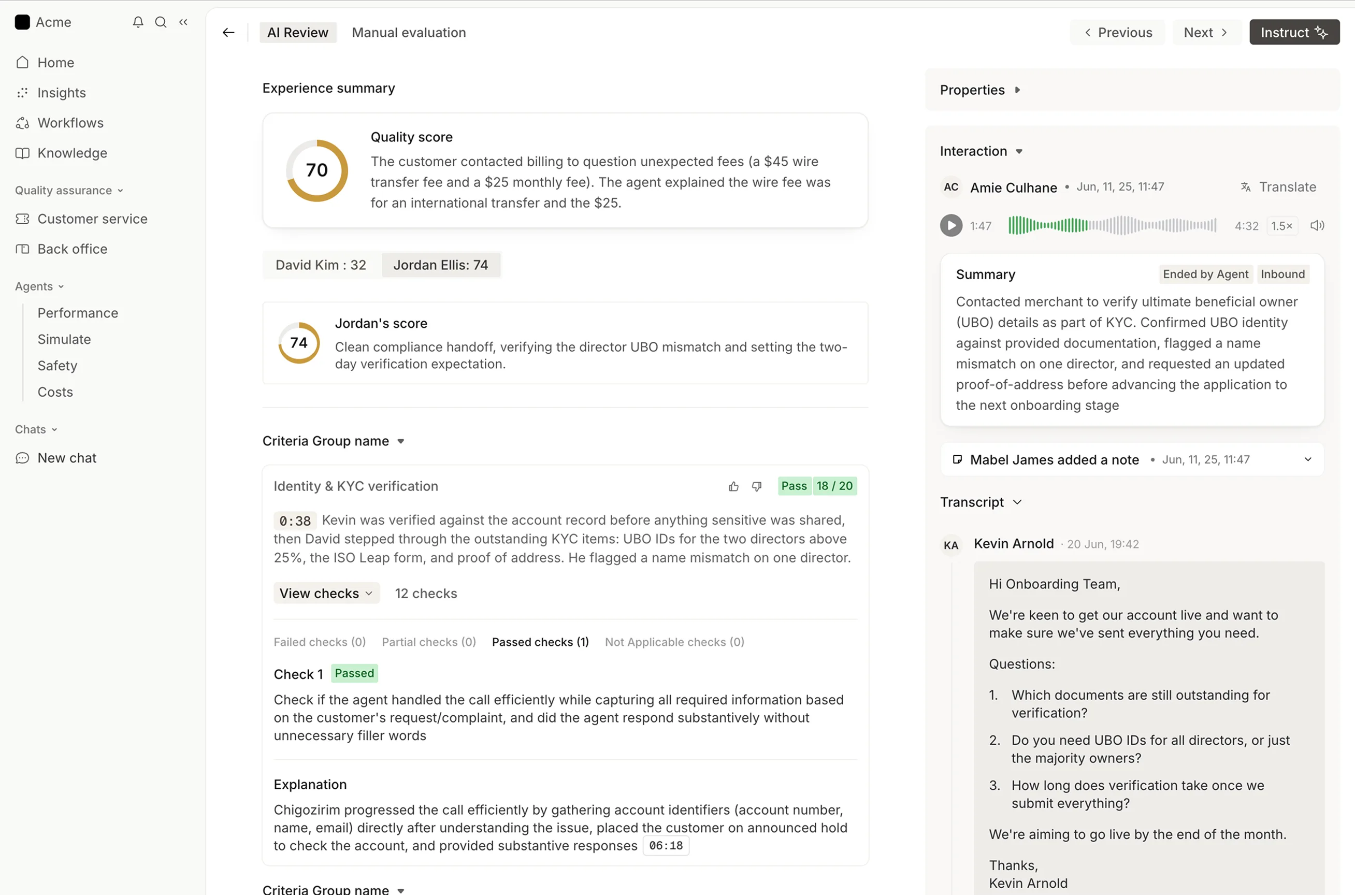
Individual scorecards drift into duplicate, vague criteria because each team writes their own rubric in a workshop. "Was professional", "showed empathy", and "good tone" multiply — and graders cannot agree on any of them.
npx rulebase-skills install cx-criterion-libraryWhen to use it
Reach for this when someone says any of these — they are the phrases the skill itself triggers on:
- “criterion library”
- “standardise our QA criteria”
- “write better rubric items”
- “was professional is too vague”
How it works
The method, in the order the skill runs it. The full procedure — tables, worked examples and the edge cases — is in the skill itself.
Step 1: Define what belongs in the library
In: Criteria reused across 2+ queues, channels, or scorecards, Auto-fail rules with regulatory or policy backing.
Step 2: Write each criterion as a decision rule
Every library entry follows the same schema.
Step 3: Version and change control
Semantic versioning per criterion: Major, Minor, Patch.
Step 4: Organise for discovery
Tag entries so scorecard authors find them.
Step 5: Governance — who owns the library
Minimum roles: Curator, Adjudication panel, Consumers.
Step 6: Compose scorecards from the library
Scorecard spec references library ids.
Step 7: Keep AI and human graders aligned
Library entries are the single source for: Human rubric text in QA UI, AI grader prompt blocks (criterion + decision rule + examples).
Step 8: Retire criteria honestly
Deprecate when: Never fails in production and carries no compliance weight, Outcome link disproven, Absorbed into another criterion (document merge mapping), Policy removed.
Related skills
Free and open source, and vendor-neutral — it reads the conversations from whichever helpdesk you already run. Browse all 149 skills · connect your helpdesk over MCP · source on GitHub