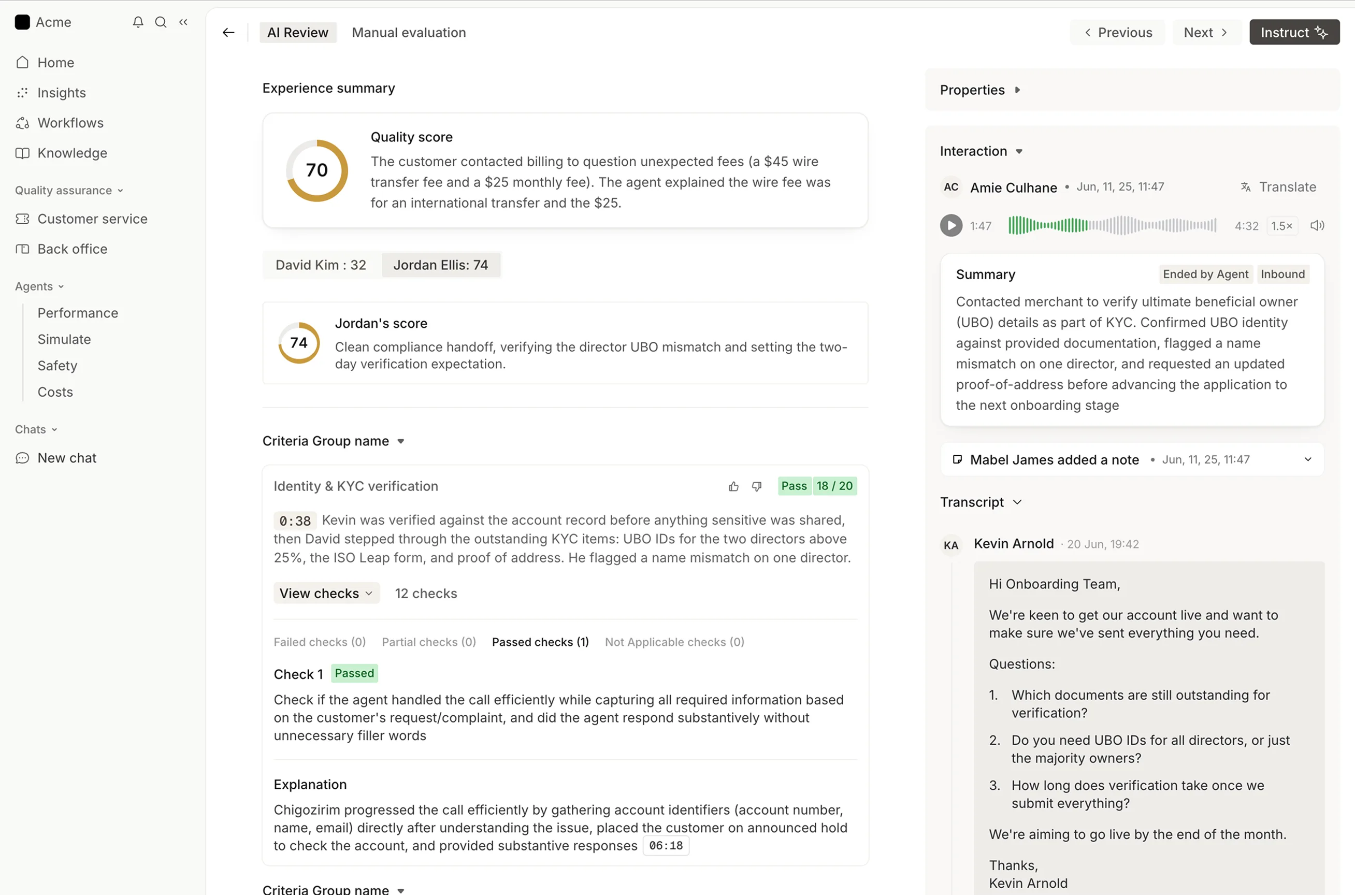
Skills Quality assurance
Validating an AI grader against humans
Teams ship AI graders on aggregate agreement: "87% match with humans." That number hides the segments where the grader is wrong often enough to be dangerous, and it conflates triage (ranking or flagging for review) with replacement (letting the AI verdict stand without a human).
npx rulebase-skills install cx-ai-grader-validationWhen to use it
Reach for this when someone says any of these — they are the phrases the skill itself triggers on:
- “can we trust the AI grader”
- “how accurate is our automated QA”
- “validate the grader before rollout”
- “AI vs human agreement by channel or language”
- “is the grader too harsh on chat”
How it works
The method, in the order the skill runs it. The full procedure — tables, worked examples and the edge cases — is in the skill itself.
Separate calibration from production agreement
Calibration — the same fixed set of conversations, graded independently by humans and by the AI grader. This is the only fair comparison when you change the grader's model or prompt.
Measure agreement by segment, not only in aggregate
Overall agreement is a headline, not a decision. Slice at least.
Diagnose noise versus bias
Two graders can disagree in opposite ways: Noise, Bias.
Choose thresholds from your costs, not from folklore
There is no universal "good enough" agreement. Derive a threshold from what happens when the grader is wrong.
Triage versus replace
Never promote from triage to replace on aggregate agreement alone. Require segment tables, a false-pass audit on stratified samples, and a plan for appeals.
Related skills
Free and open source, and vendor-neutral — it reads the conversations from whichever helpdesk you already run. Browse all 149 skills · connect your helpdesk over MCP · source on GitHub